Operating model for incidents and crises

P-DRIVEN makes crisis work governable.

P-DRIVEN is a standardized operating model for situations in which many domains must act at the same time while uncertainty is still high. The method gives teams a shared sequence, clear roles, visible boards and a team structure that scales from one incident to an enterprise-wide crisis.

Why standardized?

One shared operating logic reduces training effort and improves decision quality.

Many crisis approaches require separate terms, role models and exercise logic for each level. P-DRIVEN uses the same mechanics for CMT, IMT and DRT: Owner, Facilitator, Supporter, boards and the Problem-Solving P.

Less training effortOnce people understand the roles and boards, they recognize them at every level.
Better outcomesTeams develop several strategies before objectives and tasks are fixed.
Clear leadershipOwners decide functionally. Facilitators protect the method, sequence and work discipline.
Scalable situation workA single IMT, a DRT under a CMT and the CMT itself work with the same logic.
Problem-Solving P

Four phases organize the work from alerting to learning.

The Problem-Solving P is the working logic of P-DRIVEN. It prevents teams from mixing symptoms, problems, strategies and tasks. Each activation runs through at least one full iteration; the sequence is part of the method.

The Problem-Solving P with four phases and sixteen steps
1 · InitiationAlerting, Initial Assessment and Situation Briefing create formal activation and an initial shared picture.
2 · PlanningSituation Assessment, Situation Evaluation, Decision Taking, Objective Definition and Objective Allocation separate problem, strategy and objective.
3 · ImplementationSituation Freeze, task transmission, task processing, follow-up and situation update keep execution connected.
4 · LearningAfter deactivation, debriefing and structured feedback are captured so the organization improves.
Team structure

CMT first, then IMT and DRT: the same logic at different levels.

The team structure is deliberately standardized. Organizations do not need to learn a new working method for each crisis level. They practice one role model and apply it according to the size of the situation.

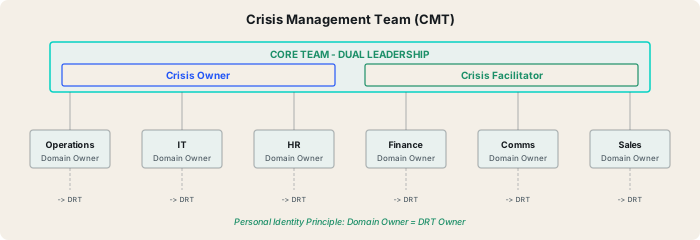
CMT with Crisis Owner, Crisis Facilitator, Domain Owners and DRT links
CMT

Crisis Management Team.

The CMT coordinates multi-domain crises. The core is the Crisis Owner and Crisis Facilitator. Domain Owners connect strategic coordination with the corresponding domains.

This is strong because functional responsibility and method discipline stay separate: the Owner leads through objectives and decisions; the Facilitator protects sequence, boards and veto logic.
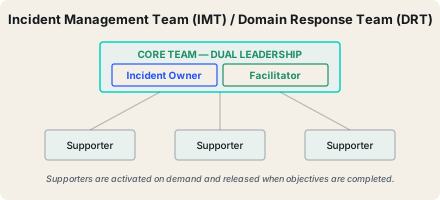
IMT and DRT with Owner, Facilitator and Supporters
IMT / DRT

Incident Management Team and Domain Response Team.

An IMT handles an incident in a single domain. A DRT is the same structure inside a larger crisis and works under CMT coordination.

The advantage is reuse: Owner, Facilitator and Supporter work the same way. Teams need less level-specific training while still achieving high process quality.

The Personal Identity Principle matters: a Domain Owner in the CMT is the same person as the Owner of the corresponding DRT. This keeps strategic coordination and operational execution connected.

Three boards

P-DRIVEN makes the path from problem to task visible.

The boards are not decoration. They are the shared work surface that keeps teams from confusing problems, solution strategies and tasks.

Board 1

Problems and priorities.

Problems are collected, clustered and prioritized by urgency and importance.

Board 2

Strategies and decision.

Several solution strategies are developed for prioritized problems before a decision is taken.

Board 3

Objectives and implementation.

Decisions become objectives, accountabilities, tasks and visible progress.

Search intents

Which P-DRIVEN entry point fits crisis teams, BCM, cyber and training?

The common questions do not create separate products; they point to useful views of the same operating model.

Exercise crisis teams

Crisis teams and incident teams get one shared working logic.

P-DRIVEN connects roles, situation briefing, boards, task transmission and debriefing into an exercisable sequence.

BCM / Resilience

Crisis handbooks become easier to exercise.

Existing incident and crisis organizations can train roles, boards and handovers with P-DRIVEN.

Cyber incident

Cyber incidents become easier to coordinate as executive situations.

Technical incident response, legal, communications, operations, management and claims work keep their mandates and work from one shared situation picture.

Training / Partners

Method contact becomes a clear qualification and licensing path.

Personal certification shows competence; organizations and training providers clarify use, material access and scope through licensing.

Entry points

From the method to the right next step.

The homepage explains the basic model. The detail pages cover downloads, application, licensing, certification, cyber context and tools.

Next step

Understand P-DRIVEN or clarify use.

Start with the Workbook and Situation Guide. If this is about official use, training, referral or partner delivery, clarify the matching frame.

Contact

Get in touch.

A few details are enough. The form sends the inquiry to post@p-driven.org.